 English
 Français
 عربى
 русский


CoreVip(Shanghai) Decoration Materials Co., Ltd. specializes in the design, research and development, and production of furniture and interior decorative panels. We are China Sandstone Series - 4x9ft Decorative Panel Series (1220×2800mm) Suppliers and Custom Sandstone Series - 4x9ft Decorative Panel Series (1220×2800mm) OEM/ODM Factory.
Our brand philosophy is rooted in the harmonious fusion of natural artistry, contemporary aesthetics, and technological innovation. We meticulously select and refine raw materials, and continuously develop surface finishes that resonate with the aesthetics and lifestyles of the new era.
True luxury speaks through the essence of materials, the balance of proportions, and the subtlety of details, never through excess. With a philosophy of deliberate reduction, CoreVip(Shanghai) Decoration Materials Co., Ltd. unveils a more sophisticated vision of spatial beauty, crafting timeless and one-of-a-kind value for each home and each living environment.
-
Decorative Cladding Panels: Material and Finish Specs for Co...
Commercial cladding projects rarely fail on appearance; they fail on documentation. A panel that looked correct on a 200 mm sample can still be rejected at handover because the fire classification covers a bare board rather than the bonded assembly, because the second production batch drifts two D...
-
7x9ft Furniture Board: Applications and Handling in Large-Sc...
A 7x9ft furniture board measures 2,070 x 2,800 mm and carries 5.80 sq m of decorative face per sheet, about 70% more surface than the 1,220 x 2,800 mm panel most plants are tooled for. That extra 850 mm of width is what makes one-piece wardrobe doors and single-span hotel casegood gables possible,...
-
Laminated Furniture Board: Judging Surface Durability, Core ...
An 18 mm cabinet door hung on a 2.4 m run shows every 0.1 mm of thickness variation the panel carries, and a thin decor paper pressed over a coarse core shows every fibre underneath it. That is why a laminated furniture board has to be approved on three separate numbers: surface wear, caliper tole...
CoreVip(Shanghai) Decoration Materials Co., Ltd. designs, develops and produces furniture and interior decorative panels, and the Sandstone Series is our stone-effect family in the 1220 × 2800 mm sheet format. We build the panels on particleboard, MDF or plywood cores and finish them in Shanghai, where a 23,000 m² plant and 18 production lines support both standard programme supply and project-specific configuration. The range is used by joinery manufacturers, distributors and interior contractors who need one sandstone surface carried consistently across wall cladding, cabinet fronts and door panels.
As a Wholesale Sandstone Series - 4x9ft Decorative Panel Series (1220×2800mm) Suppliers, CoreVip controls substrate screening, adhesive application, pressing and surface finishing in one continuous flow. Each sheet measures 1220 × 2800 mm and carries 3.42 m² of decorative face, a proportion that suits full-height wardrobe sides, door blanks and continuous wall runs with fewer joints than a 2440 mm board allows.
Where the Sandstone Surface Fits
As a Custom Sandstone Series - 4x9ft Decorative Panel Series (1220×2800mm) OEM/ODM Suppliers, Factory, we match product configuration to the application, operating limits, interfaces and acceptance criteria defined for each project.
Sandstone reads as sedimentary stone: soft banding, fine mineral grain and a low-contrast palette that holds up under daylight without the veining drama of marble. That quiet character makes it a practical choice for large surface areas where a strong pattern would become tiring across repeated panels, and for interiors where stone is wanted without the weight, joint width and fixing depth of solid material.
- Residential joinery: wardrobe fronts, kitchen tall units, bathroom vanities, headboard walls.
- Commercial interiors: hotel guest-room cladding, lobby feature walls, retail fixtures, reception desks.
- Door and partition work: flush door skins, sliding partition faces, matching architraves.
- Mixed-material schemes: sandstone fields combined with wood grain or solid colour panels from the same format.
Our Range in the 4x9ft Format
The Sandstone Series sits inside a wider 4x9ft Decorative Panel Series (1220×2800mm) where every surface family shares the same sheet size and substrate logic. That shared geometry is what allows a project to specify one substrate build and one edge-banding system while varying the decor room by room.
| Series | Surface character | Where it fits |
|---|---|---|
| Sandstone | Fine mineral grain, soft stratification, low contrast | Large wall fields, stone-look joinery, quiet hospitality interiors |
| Wood Grain | Oak, walnut and elm linework in beige and smoked tones | Cabinetry, wardrobe interiors, furniture carcasses |
| Solid Color | Flat, unpatterned colour fields | Minimalist fronts, colour blocking, panel infill |
| Fabric Texture | Woven and linen-effect relief | Soft-detail wardrobes, acoustic-look walls, bedroom joinery |
| Stone & Marble | Veined and brecciated stone effects | Statement walls, table tops, reception counters |
| Leather Texture | Grained and stitched leather looks | Headboards, cabinet doors, hospitality casework |
| Metallic | Brushed and satin metal effects | Retail fixtures, back panels, accent detailing |
| Wood Veneer | Realistic veneer figure and colour depth | Premium furniture, boardroom and lounge joinery |
| Abstract | Graphic and free-form pattern | Feature walls, retail display, design-led interiors |
| Premium Door Panel | Door-oriented decor and face build | Interior doors, integrated door-wall-cabinet schemes |
Where a scheme moves toward veined stone rather than sedimentary banding, the Stone & Marble Series uses the same sheet size and substrate system, so both can be specified in one project and cut on the same line. A reference decor from the Sandstone family, the Sandstone 4x9ft Decorative Panel VS-323, shows the surface at full sheet scale for approval before production.
Sheet Format, Substrate and Configuration Choices
We configure the sandstone face around the load path and machining the panel will meet in the workshop, not around the decor alone. The table below shows the fields we settle with you before a production slot is booked.
| Parameter | Options we work to | Why it matters downstream |
|---|---|---|
| Sheet size | 1220 × 2800 mm (4 × 9 ft), 3.42 m² per sheet | Allows full-height sides and door blanks without a mid-panel joint |
| Core substrate | Particleboard, MDF, multilayer plywood | Sets screw-holding, routing behaviour and weight per cabinet run |
| Thickness | Confirmed per application and fitting system | Drives hinge and slide selection on doors and drawers |
| Surface treatment | Pressed decorative face with finish level agreed at approval | Controls reflection, touch and sheen consistency across panels |
| Edge treatment | Matching PVC edge banding; seamless one-piece curved edge | Keeps the sandstone reading continuous around corners and reveals |
| Repeat pattern | Sheet layout drawn to the facing area before cutting | Avoids banding misalignment between adjacent panels |
Fabrication, Edging and Installation on 2800 mm Sheets
A 2800 mm sheet changes handling more than it changes appearance. We plan the format so that cutting, edge banding and site installation each have a defined sequence.
- Cutting plans are laid out from your cutting list so grain and banding run in one direction across a run of panels.
- Edge-banded components should be trimmed and banded within a short window of cutting to keep the joint line tight.
- Vertical wall cladding needs a fixing substrate that is flat and plumb; the panel follows the wall, so tolerance is set there.
- Panels are heavy at this size — plan two-person handling, and allow for crane or lift access on upper floors.
- Acclimatise sheets in the destination space before fixing, and protect faces during installation rather than after.
Quality Control and Documentation
Raw materials are screened before they enter production: supplier auditing, incoming material inspection and comparative testing against approved references. Within the line, we control adhesive application and pressing to limit bubbles, wrinkles and delamination, then refine the surface to hold colour, texture and visual flatness across the batch. In-process inspection follows the run rather than the reel, so drift is caught before packing.
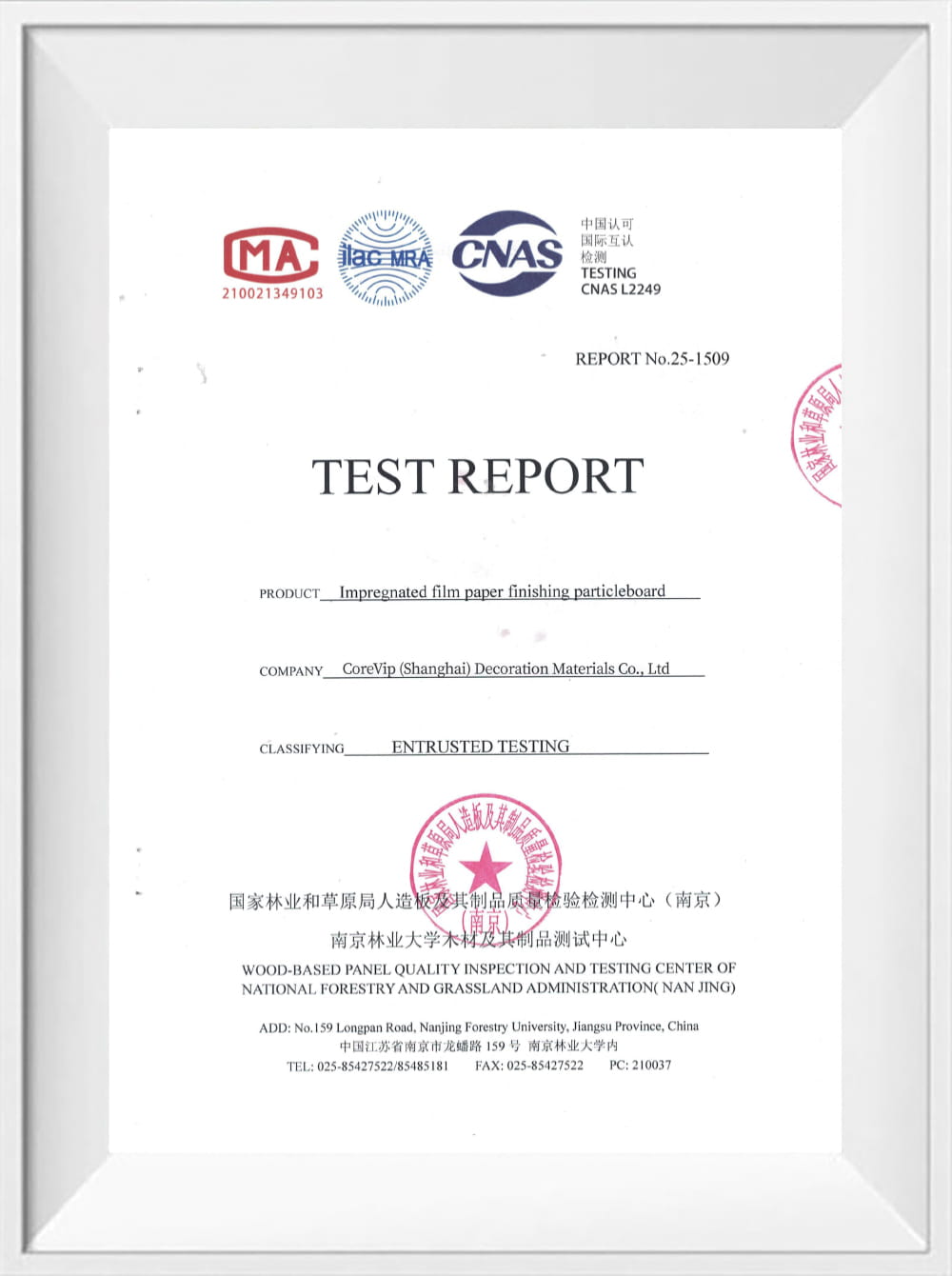
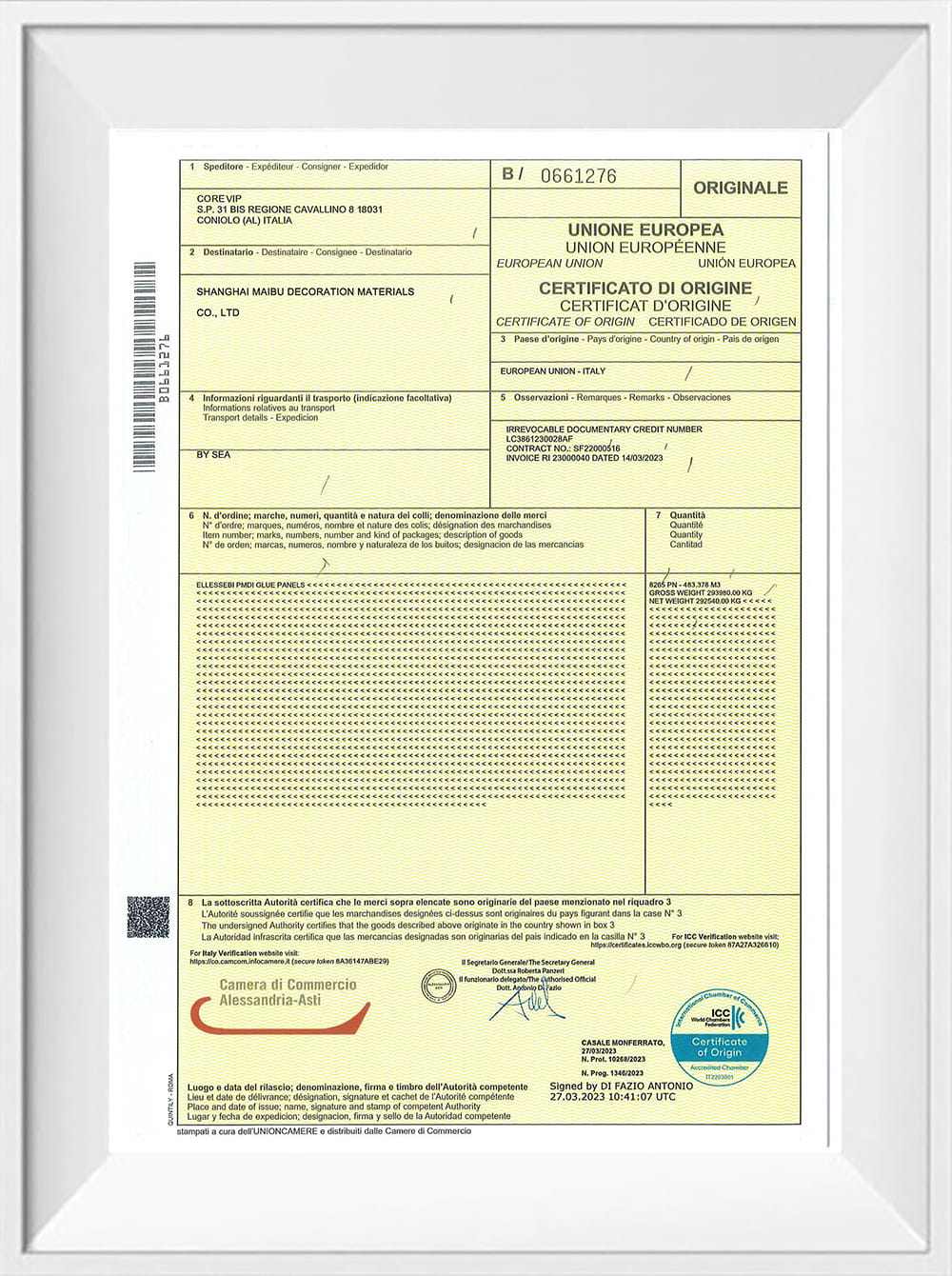
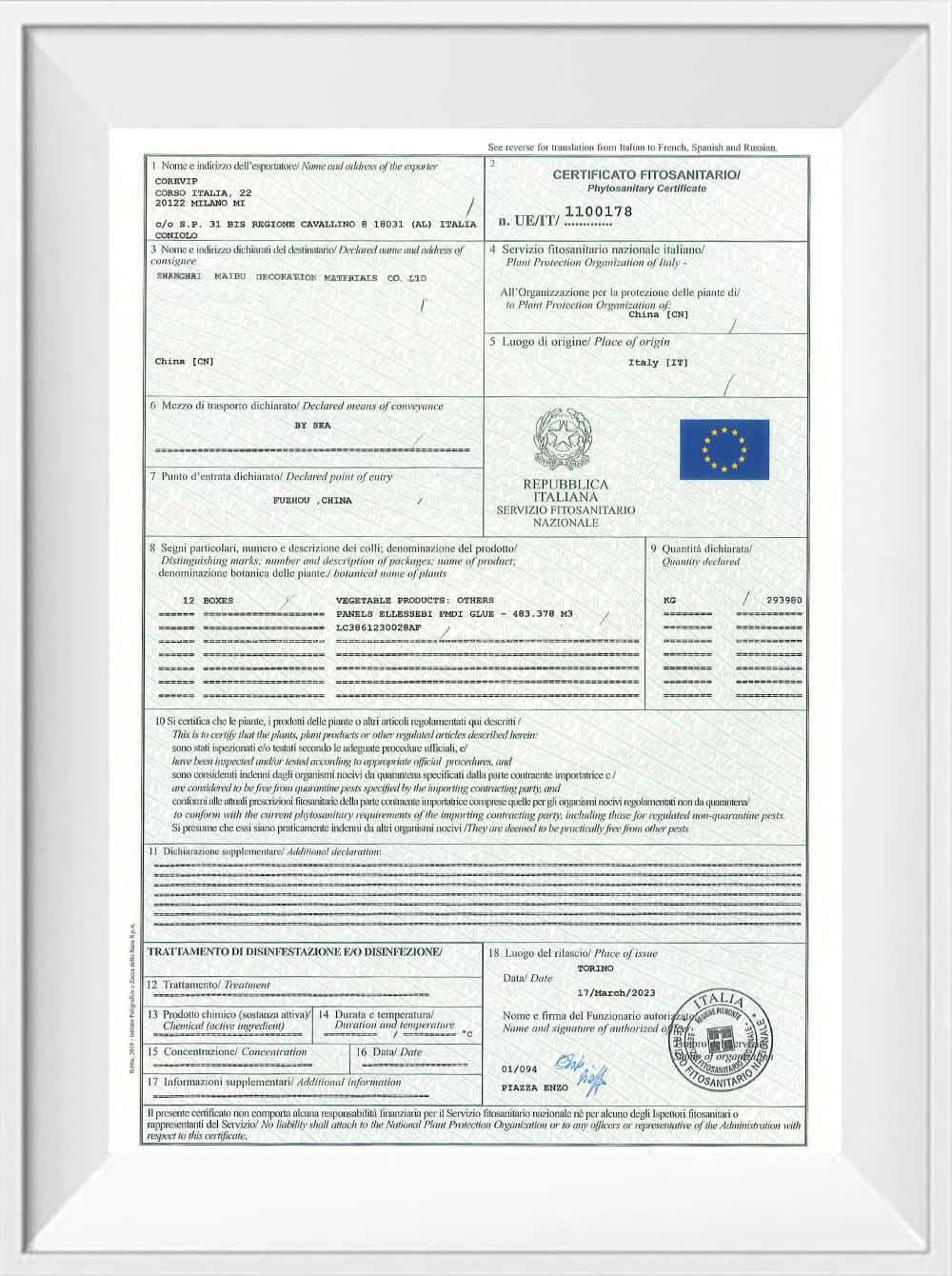
Consignments are issued with a CoreVip Inspection Report, Certificate of Origin and Quality Inspection Certificate, and project files can draw on our collection brochures and test documentation for submittals and handover packs.
Information We Use to Configure Your Solution
- Decor reference or approved sample, plus any colour-direction notes against the VS-323 reference.
- Application: wall cladding, cabinet fronts, door skins, partitions or mixed use — and whether wet areas are involved.
- Substrate and thickness required by your fitting system, or the load and fixing conditions we should design to.
- Cutting list with quantities, or a facing-area schedule if you cut in-house.
- Edge banding requirement: matching PVC, curved edge components, or unbanded sheets.
- Surface finish and gloss direction, and whether panels sit in the same sightline as another series.
- Destination, transport mode and pack/labelling requirements.
Packing, Delivery Scope and Repeat Supply
Packing scope is agreed against the order: sheets per stack, face and edge protection, labelling and whether a container is loaded with a single sandstone decor or a mixed programme across series. For distributors, we hold the decor reference with the order record so that a repeat call-off can be matched to the approved surface rather than to a photograph.
Custom production covers substrate, sheet thickness and colour direction, and the same surface system can be extended across doors, walls and cabinets for a unified interior. Warranty terms, lead times and delivery schedules are set out in the commercial documents issued with each order.
Frequently Asked Questions
What exactly is the Sandstone Series panel?
It is a 1220 × 2800 mm decorative panel with a sandstone-effect face — fine mineral grain and soft sedimentary banding — built on particleboard, MDF or plywood. Each sheet gives 3.42 m² of usable decorative face, and the same sheet can serve wall cladding, cabinet fronts and door skins in one scheme.
Which substrate should we choose for a sandstone project?
Particleboard is the usual choice for carcass and panel infill, MDF gives cleaner routing for profiled door edges, and multilayer plywood suits applications needing higher screw-holding or moisture tolerance. We confirm thickness together with the hinge, slide and fixing system you intend to use.
Can sandstone and wood grain panels be used in the same room?
Yes. Every series in the 4x9ft format shares the same sheet geometry and substrate options, so a sandstone wall field can sit against wood grain cabinetry with matching edge banding and consistent panel thickness throughout.
Do you supply edge banding with the panels?
Matching PVC edge banding is part of our decorative range, and we also offer seamless one-piece curved edge components where a corner has to read as a continuous surface. Banding is quoted alongside the panel so colours are matched at the source rather than in the workshop.
What documents come with a sandstone consignment?
Each order is issued with a CoreVip Inspection Report, Certificate of Origin and Quality Inspection Certificate. Collection brochures and available test documentation can be supplied for submittals, and we confirm the document set required for your market when the order is placed.
How should sandstone panels be maintained after installation?
Dust with a dry or slightly damp soft cloth and avoid abrasive pads, solvent cleaners and standing water at exposed edges. Where panels are used in kitchens or vanities, wipe spills promptly and keep the edge-banded joints sealed so the core stays dry.


Copyright © CoreVip(Shanghai) Decoration Materials Co., Ltd. Rights Reserved.
Custom Sandstone Series - 4x9ft Decorative Panel Series (1220×2800mm) OEM/ODM Suppliers
